Laboratory high-purity water equipment

Purified water equipment is used in various industries requiring GMP certification, primarily in the biochemical industry. It is typically constructed from stainless steel and equipped with sterilization and disinfection equipment before the water is consumed. The latest technologies, such as reverse osmosis (RO) and EDI, are typically employed. Complete sets of high-purity water treatment processes are specifically designed to meet the water requirements of medical device manufacturers for purified water production and water for injection.

1. Basic Content

GMP-certified purified water equipment for the biochemical industry

(1) Water quality complies with the 2010 edition of the Pharmacopoeia standards and various provisions of GMP

(2) Equipment operates fully automatically and conditionally has fully automatic processing procedures (such as backwashing, regeneration, pickling, and disinfection procedures)

(3) Units and pipeline equipment meet GMP requirements (for example, back-end processing equipment such as sterilizers, membrane filters, terminal water tanks, and pipelines are all made of 316L material, and pre-treatment equipment pipelines are made of UPVC pipes)

2. Purified Water Equipment Process

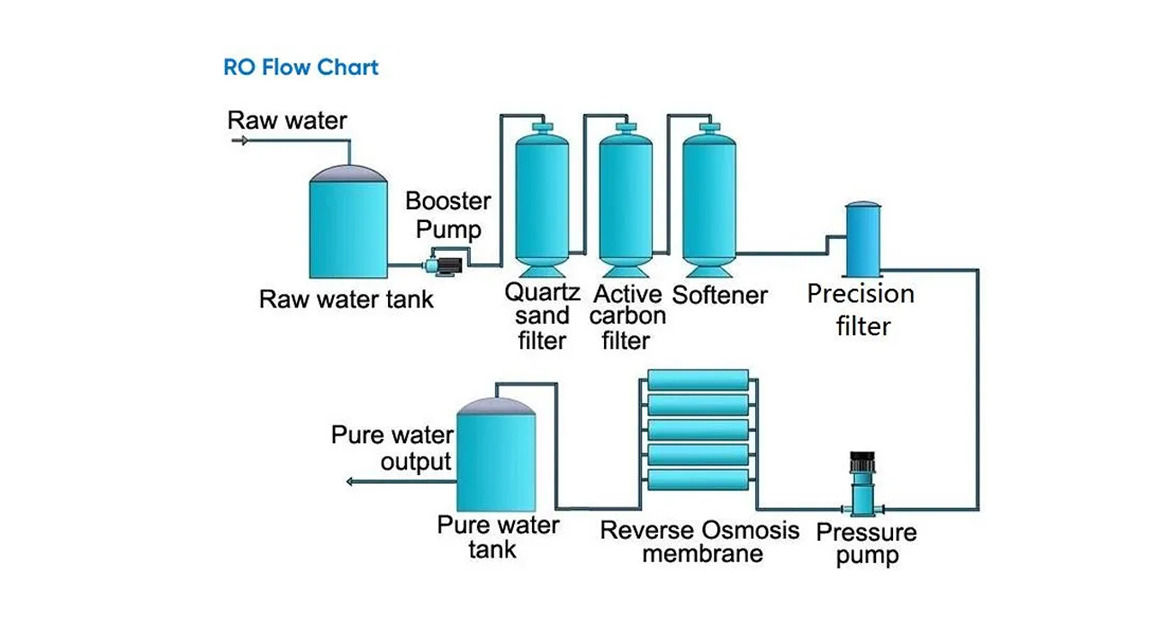
1. Raw Water - Raw Water Booster Pump - Multi-Media Filter - Activated Carbon Filter - Water Softener - Precision Filter - First-Stage Reverse Osmosis - pH Adjustment - Intermediate Water Tank - Second-Stage Reverse Osmosis - Purified Water Tank - Pure Water Pump - UV Sterilizer - Microporous Filter - Water Point

3. Classification and Quality Indicators of Water Used in Biochemical Production

1. Classification of Water Used in Biochemical Production (Process Water: Water used in biochemical production processes, including drinking water, purified water, and water for injection)

1) Potable Water: This is typically tap water or deep well water supplied by a water company, also known as raw water. Its quality must comply with the national standard GB5749-85, "Sanitary Standard for Drinking Water for Domestic Use." According to the 2000 Chinese Pharmacopoeia, potable water cannot be used directly for the preparation or testing of pharmaceutical products.

2) Purified Water: This is water used in biochemical processes, produced from raw water by distillation, ion exchange, reverse osmosis, or other suitable methods. It contains no additives. Purified water can be used as a solvent or test water for the preparation of common pharmaceutical preparations, but should not be used for the preparation of injectables. Purified water produced by non-thermal treatment methods such as ion exchange, reverse osmosis, and ultrafiltration is generally called deionized water. Purified water produced by distillation using specially designed distiller is also generally called distilled water.

3) Water for Injection: This is water obtained by distilling purified water in a specially designed distiller, condensing and cooling it, and then filtering it through a membrane. Water for Injection can be used as a solvent for preparing injectables.

4) Sterile Water for Injection: This is water prepared according to the injection production process. Sterile Water for Injection is used as a solvent for sterile powders or as a diluent for injection solutions

4. Water Quality Standards for Biochemical Processes

1) Drinking Water: Must comply with the National Standard of the People's Republic of China, "Sanitary Standard for Drinking Water" (GB5749-85).

2) Purified Water: Must comply with the standards for purified water as specified in the 2000 Chinese Pharmacopoeia. In water production processes, online testing of the resistivity of purified water is commonly used to reflect the concentration of various ions in the water. Purified water in the pharmaceutical industry typically has a resistivity of ≥0.5 MΩ.cm/25°C. Purified water used for rinsing injection and eye drop containers should have a resistivity of ≥1 MΩ.cm/25°C.

3) Water for Injection: Must comply with the standards for water for injection as specified in the 2000 Chinese Pharmacopoeia.