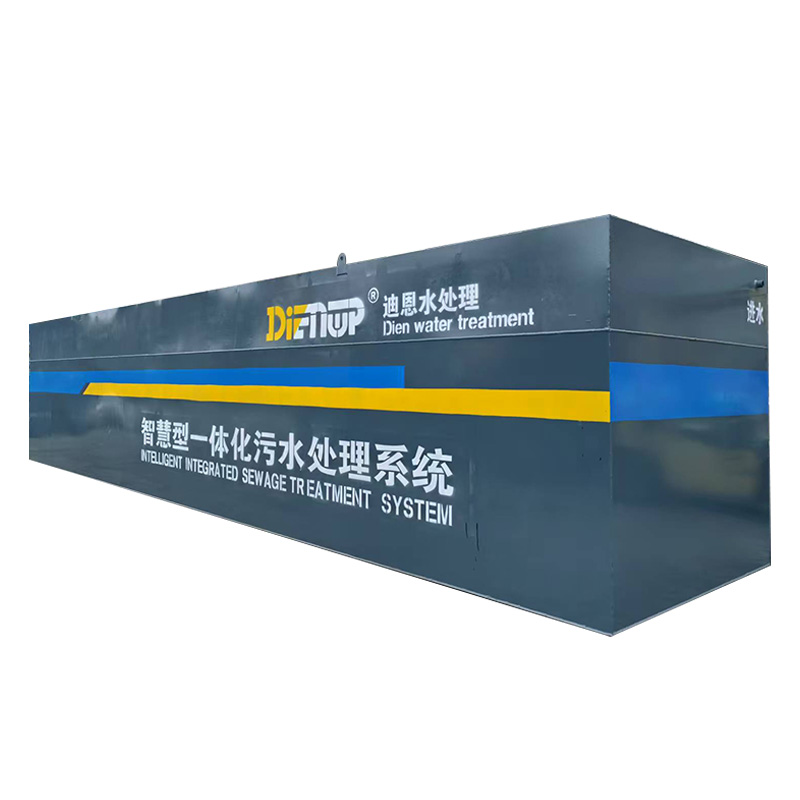
Domestic Wastewater treatment Equipment
Working Principle
The removal of organic pollutants and ammonia nitrogen in this series of wastewater treatment equipment primarily relies on the AO biological treatment process within the equipment. The operating principle is that in the A-stage tank, due to the high organic matter concentration in the wastewater, the microorganisms are in an anoxic state. At this time, the microorganisms are facultative. Therefore, the A-stage tank not only has a certain organic matter removal function, but also reduces the organic load in the subsequent aerobic tank. Although the organic matter concentration is reduced, a certain amount of organic matter and a high level of NH3-N still exist. To further oxidize and decompose organic matter and facilitate nitrification under carbonization, an aerobic biological contact oxidation tank with a lower organic load is installed in the O-stage tank.
The O-class pools primarily contain aerobic microorganisms and autotrophic bacteria (nitrifying bacteria). Aerobic microorganisms decompose organic matter into CO2 and H2O. Autotrophic bacteria (nitrifying bacteria) use inorganic carbon produced by the decomposition of organic matter or CO2 in the air as a nutrient source to convert NH3-N in the wastewater into NO-2-N and NO-3-N. The effluent from the O-class pools partially flows back to the A-class pools, providing electron acceptors for the A-class pools, ultimately eliminating nitrogen pollution through denitrification.