Water Softening Equipment

Water softening equipment, as the name suggests, reduces water hardness by primarily removing calcium and magnesium ions from the water. This process reduces the total salt content in the water and is widely used in hot water boiler systems, heat exchange systems, industrial cooling systems, central air conditioning systems, and other water-using systems.

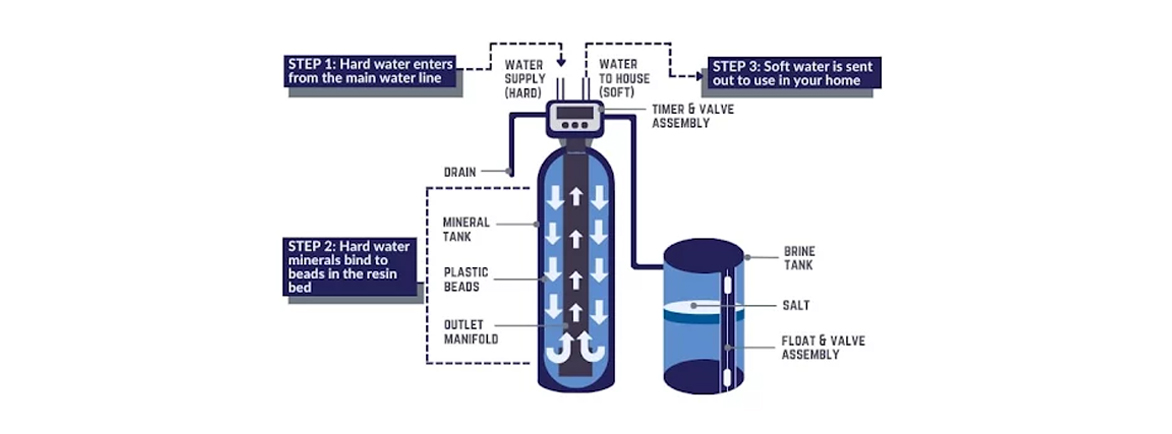
Water softening equipment uses an ion exchange process (a chemical method) that works as hard water passes through a resin layer. The calcium and magnesium in the water are exchanged for sodium in the resin, producing soft water. When the resin reaches saturation with calcium and magnesium ions, its softening capacity decreases, requiring regeneration with highly concentrated brine. This regeneration process releases the adsorbed calcium and magnesium ions, restoring its exchange capacity.

Water softening equipment uses membrane separation (a physical method) to work: The core of membrane separation technology lies in the membrane's selective permeability, which allows certain components to pass through the membrane while others are retained, thereby achieving separation of solute and solvent. The membrane separation process primarily relies on external energy, such as pressure differentials, electric fields, or concentration gradients, to effectively separate different components in a liquid. Reverse osmosis (RO) membrane separation technology is commonly used in the water softening field.

Applications

Boiler water softening equipment can be widely used to soften feed water for steam boilers, hot water boilers, heat exchangers, evaporative condensers, air conditioners, direct-fired engines, and other systems. It can also be used to treat domestic water in hotels, restaurants, office buildings, apartments, and homes, as well as soften water in the food, beverage, brewing, laundry, printing and dyeing, chemical, and pharmaceutical industries.