Chlorine dioxide generator

Chlorine dioxide (ClO2) is a yellow-green to orange gas at room temperature, with color changes depending on its concentration. It has a pungent odor. Its boiling point is 11°C and its melting point is -59°C. It is readily soluble in water, with a solubility approximately five times greater than that of chlorine. Its dissociation constant under neutral conditions is 1.2×10⁻⁷, meaning it remains essentially undissociated. Chlorine dioxide is readily absorbed by sulfuric acid but does not react with it. It is also soluble in carbon tetrachloride and glacial acetic acid.

Chlorine dioxide is highly volatile and escapes from solution with even the slightest aeration. However, chlorine dioxide is an explosive gas, and its decomposition is accelerated by heat and light. Chlorine dioxide detection methods are still incomplete, and analytical testing is complex, requiring a relatively high level of operational management.

Chlorine dioxide has a strong oxidizing power, with a theoretical oxidizing capacity 2.63 times that of chlorine. It can attach to and penetrate cell walls, reacting with sulfhydryl-containing enzymes to kill bacteria. Chlorine dioxide undergoes redox reactions with some amino acids in bacterial and other biological proteins, causing their breakdown and destruction, thereby inhibiting microbial protein synthesis and ultimately killing the bacteria. Chlorine dioxide offers the following advantages as a drinking water disinfectant.


1. Chlorine dioxide does not react with fulvic acid, humic acid, and other substances in water to form disinfection byproducts such as chloroform and halocaproic acid

2. Chlorine dioxide does not react with ammonia and nitrogen in water, resulting in a more effective bactericidal effect than chlorine. Furthermore, it requires less dosage, acts more quickly, and is unaffected by water pH, temperature, or ammonia and nitrogen concentration.

3. Its strong oxidizing properties effectively kill spores and viruses that are less effective with chlorine disinfection. It can also effectively remove harmful substances such as algae, phenols, cyanides, and sulfides from water, providing excellent decolorization and deodorization effects. However, the disadvantages of this method are high disinfection costs, difficult storage, and excessive dosage, which can produce inorganic byproducts such as chlorite. Because residual chlorine dioxide in water is more volatile than residual chlorine, it is generally consumed at a higher rate than residual chlorine.

Preparation of Chlorine Dioxide

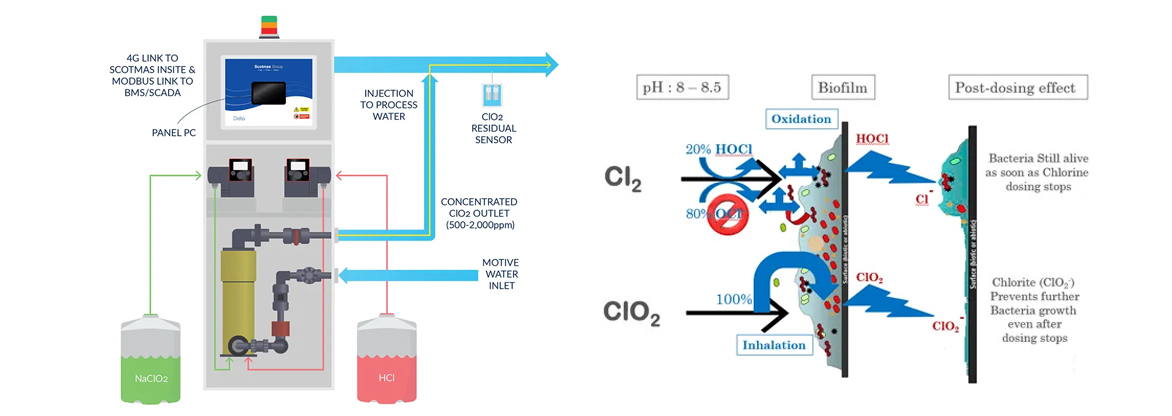
Chlorine dioxide can be prepared by electrolysis, activation of stabilized chlorine dioxide, and chemical methods.

① Electrolysis: Similar to the production of sodium hypochlorite by electrolysis of salt water, the electrolysis method produces chlorine dioxide by electrolyzing salt water and sodium chlorate solution. However, this method has a limited lifespan for the diaphragm and electrodes, produces low concentrations of chlorine dioxide, and requires complex equipment and difficult operation and maintenance.

② Stable chlorine dioxide activation method. Chlorine dioxide is unstable and generally requires on-site production. To achieve this, high-purity chlorine dioxide is first produced and stabilized with stabilizers such as carbonates for easy storage and transportation. Upon use, it is activated with activators such as hydrochloric acid to produce chlorine dioxide. While stable chlorine dioxide is easy to use, it is relatively expensive and is only suitable for small-scale water disinfection in economically affluent areas.

③ Chemical methods: Chemical methods are currently the most commonly used methods for drinking water purification, including the chlorate and chlorite methods.