
Reverse osmosis membrane
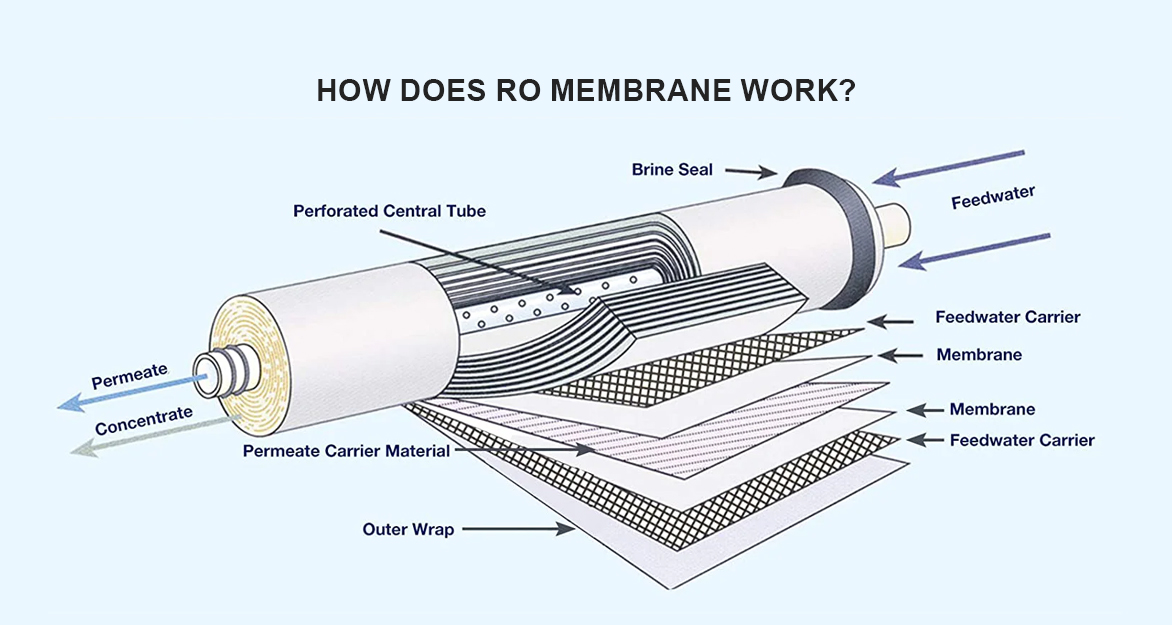
Reverse osmosis membranes should have the following characteristics: (1) high desalination rate at high flow rate; (2) high mechanical strength and service life; (3) ability to function at low operating pressure; (4) ability to withstand the effects of chemical or biochemical reactions; (5) less affected by factors such as pH value and temperature; (6) easy to obtain raw materials for membrane production, simple processing, and low cost.
Performance Indicators
Desalination Rate
Desalination Rate = (1 – Product Water Salt Content / Influent Salt Content) × 100%
Permeation Rate
Water flux refers to the water production capacity of a reverse osmosis system, that is, the amount of water that passes through the membrane per unit time, usually expressed in tons/hour or gallons/day.
Salt permeation rate refers to the amount of salt that passes through a unit membrane area per unit time, also known as salt permeability or salt flux.
Recovery Rate
Recovery rate refers to the percentage of feed water converted into product water or permeate in a membrane system. It depends on the quality of the pretreated influent and water requirements. The recovery rate of a membrane system is determined during design.
Recovery rate = (product water flow rate / influent flow rate) × 100%
Cleaning Steps
Water Supply and Process Water Treatment (Separation, Concentration, Fractionation, and Purification)
In various industrial processes, there is often a need to separate, concentrate, fractionate, and purify aqueous solutions. Traditional methods include precipitation, filtration, heating, freezing, distillation, extraction, and crystallization. These methods exhibit disadvantages such as lengthy processes, high energy consumption, significant material losses, bulky equipment, low efficiency, and cumbersome operation. Replacing certain traditional technologies with ultrafiltration membrane technology can yield significant economic benefits.
Reverse osmosis systems eventually require cleaning. This is recommended if your RO system shows signs of contamination, before an extended outage, or during scheduled maintenance. The following signs of contamination (a 10-15% decrease in normalized permeate flow, a 10-15% decrease in normalized permeate quality, or a 10-15% increase in the pressure drop between the feed and concentrate) indicate that your RO system needs cleaning.
Using RO product water to flush out fouling is often overlooked in RO system design. This method can reduce the frequency of RO cleanings. Soaking the RO membrane components with product water during equipment downtime helps dissolve scale and loose deposits, thereby reducing the frequency of chemical cleanings.